

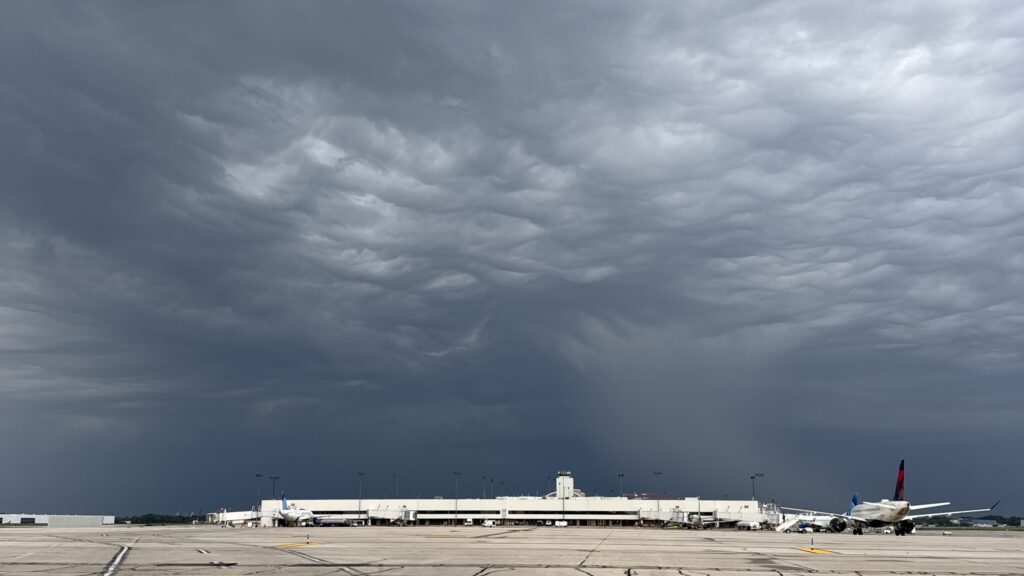
Summer storms can move quickly. One minute, flights are moving and bags are being loaded. The next, lightning rolls into the area and activity outside the terminal comes to a stop.
Then the storm passes, the skies clear and you may find yourself wondering: Why is my flight still delayed?
There’s a lot happening behind the scenes when severe weather moves through an airport. Here’s what you should know.
When lightning moves in, safety comes first
Airlines have their own safety policies for lightning and severe weather within a certain radius of the airport. When conditions meet those thresholds, airlines may suspend outdoor ground operations to protect their employees.
That means the people working outside head indoors and stay there until conditions are safe.
There are no shortcuts when it comes to severe weather. Safety is always the priority.
And, just for the record: the airport does not control the weather. We checked.
A lot of your flight happens outside the plane
Before an aircraft can leave the gate, there’s an entire team working outside to get it ready.
Ramp agents and other ground personnel are loading and unloading bags, fueling aircraft, moving equipment, guiding planes, handling cargo, and completing other essential work.
Those jobs already take place around large aircraft and specialized equipment. Add lightning to the equation, and continuing to work outside simply isn’t worth the risk.
So when outdoor operations are suspended, some of the work required to get flights moving safely has to wait, too.
The storm passed. Why is my flight still delayed?
This is where things can get complicated.
When a storm pauses ground operations, the clock doesn’t pause with it. Flights continue to arrive in the area. Aircraft may be waiting for gates. Bags need to be unloaded and loaded. Planes need to be serviced. Departures that were scheduled throughout that period are now waiting to move.
Once conditions are safe and crews can return outside, everyone gets back to work. But now they’re also working through everything that stacked up while operations were suspended.
Think of it less like flipping a switch and more like clearing a traffic jam.
One storm can have a ripple effect
An hour of severe weather doesn’t necessarily mean an hour-long delay.
Airline operations are highly interconnected. The aircraft taking you from Columbus to your destination may have arrived from another city, and after your flight, it may be scheduled to continue somewhere else. Flight crews and other resources are moving through their own schedules, too.
A delay in one place can ripple through an airline’s network, affecting flights hours later and hundreds of miles away.
That’s why you may still see delays even when the storm clouds have moved on, or if the sun never stopped shining where you were to begin with.
What can passengers do?
When severe weather is in the forecast, a little preparation can make navigating the day easier:
- Stay connected to your airline. Check your airline’s mobile app or website for the most up-to-date information about your specific flight.
- Give yourself extra time. Severe weather can make an already busy travel day less predictable.
- Be patient with the people helping you. Airline employees, ground crews and airport teams are working to get everyone moving again as safely and efficiently as possible.
Most importantly, remember that a weather delay isn’t just about the weather happening at that exact moment. It’s about keeping the people working around your aircraft safe and managing everything that happens next.
Storms are unpredictable. Safety shouldn’t be.