

In the 25 years since September 11, 2001, our country, our industry, and our world have changed significantly. What began as a sunny Tuesday morning became a day marked by confusion, tragedy, and, amidst it all, extraordinary acts of humanity. The impact on the aviation industry was profound and lasting as airports faced a unique set of challenges. Many of the evolving procedures and security measures continue to shape the way we travel and operate today.
Twenty-five years later, Columbus Regional Airport Authority employees who experienced that day firsthand reflect on what they remember, how airport operations changed, and what has stayed with them.
When everything changed
John Glenn Columbus International Airport (CMH) Operations staff were in their regular Tuesday meeting when Mary Jo, a communications tech, walked in and said a plane had hit the World Trade Center. Initial reaction was confusion, not alarm, and the meeting continued.
“At first, we thought it was a single-engine airplane that flew through fog or bad weather and hit the building by accident,” said Mike Taylor, Supervisor, Airport Operations, who was an Ops Coordinator in 2001.
About 20 minutes later, Mary Jo came back in and said another airplane hit the other Twin Tower.
Bryan Schreiber, Manager, Air Cargo Business Development, was also in that meeting and remembers the confusion of that morning.
“I was a young Airport Operations Coordinator. The only thought in my mind at that point was, ‘We are under attack.’ I didn’t know from where or from whom, but this kicked off the longest day of my life. I think I worked 20 hours that day.”
And outside the Operations meeting, more employees were learning about what was going on.
“I was working on pavement repairs from inside a loader,” explained Rusty Gregg, Airfield Maintenance Operator II. “My wife, Allison, called me shortly after 8:46 a.m., saying that a plane had struck the World Trade Center. I assumed it must have been a small aircraft and a terrible accident. She asked if I had heard anything through the airport. I hadn’t so I shouted down to the guys I was working with that a plane had hit the World Trade Center, and then we just went back to work. None of us could comprehend what was actually unfolding.”
“I was working in the old Maintenance shop and the breaking news came on the TV,” said Jim Foster, Technician, Building Automation. “We were watching the first tower after it got hit.”
Initial confusion quickly gave way to the realization that something much more serious was happening.
“I was a seasonal landscaper and was mowing on International Gateway,” said Amy Russell, now Supervisor, Aviation Security. “The supervisor came to tell me to go back to the Airfield Maintenance building because a plane hit the World Trade Center. By the time I got there, the second plane had hit.”
“Allison called me back about 15 minutes later and her voice was different,” said Rusty. “She told me another plane had hit the other tower. Even then, my mind struggled to accept what she was telling me. My manager hadn’t heard anything either so she called the air traffic control tower to ask if they knew what was happening. Their response was, ‘No, we haven’t heard that.’ Within minutes, everything changed and we were instructed to return immediately to the Airfield Maintenance building.”
Marc Sethna, Chief Operations Officer, was working at Rickenbacker International Airport (LCK) that day. While civilian aviation shut down nationwide, military activity at Rickenbacker increased significantly. The Ohio Air National Guard’s 121st Air Refueling Wing, based at LCK, quickly became extremely busy. The sharp contrast between grounded civilian flights and increased military operations stayed with him.
“In airport operations, no two days are exactly the same, but September 11 obviously became a day unlike any other,” said Marc.
“When I walked into the breakroom, the atmosphere was unlike anything I’ve experienced,” said Rusty. “It was packed and everyone was gathered around the TV, watching the horrifying footage replay over and over again. People stood in disbelief as the realization that America was under attack began to sink in. I called Allison and told her to take our two young daughters and go home. Like countless other Americans that morning, I didn’t know what would happen next, only that I wanted my family together and safe.”
The proximity of Flight 93’s crash in Pennsylvania to Ohio was the turning point for Erin Fellows, Director, Accounting & Finance, making the threat feel closer to home. ”I realized that’s not too far from us,” she said.
Grounding the nation
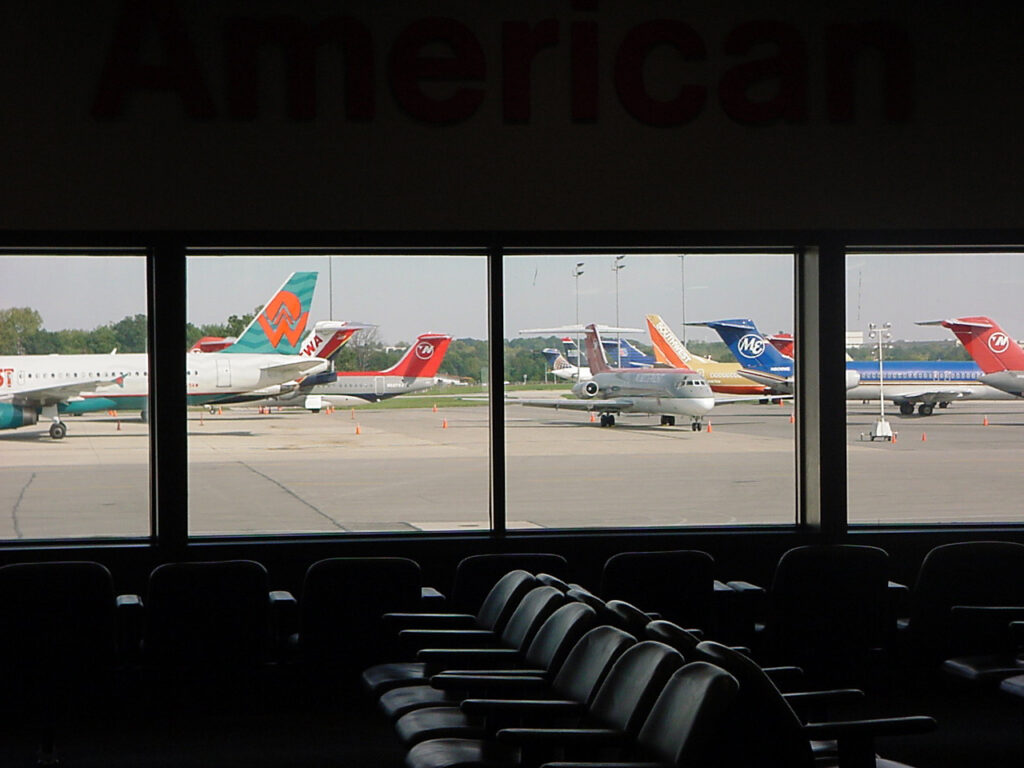
The rest of the day at our airports was a blur of lockdown protocols, military and police presence, and an uncomfortable stillness on the ramps that are normally alive with noise. No one knew how many diverted planes to expect; Operations just handled aircraft as they arrived, parking oversized or unfamiliar carriers wherever space allowed, with staff waving them in since air traffic control couldn’t assign gates as normal.
“We started getting word that they’re shutting down the national airspace, and then we started hearing that this this may be a terrorist act,” said Mike. “We canceled the Operations meeting and started making contingency plans and meeting with air traffic control. Basically, wherever the aircraft were over the U.S. or coming into the U.S., the FAA ordered them to land at the nearest airport they could. We were preparing to get a large influx of airplanes.”
And, at LCK, there was a very different, but still shocking, situation. “We learned that air traffic across the country was being stopped,” said Marc. “It was a strange thing to see the civilian aviation system essentially come to a halt.”
By 12:16 p.m., U.S. airspace had been cleared of all aircraft except military and essential emergency flights – the first shutdown of civil aviation in U.S. history.
Joe Herrmann, Manager, Airport Operations and at the time an Operations Coordinator, went out onto the airfield to help park diverted aircraft, including a TWA 767 – an aircraft CMH didn’t typically handle and didn’t have the equipment to unload.
“I don’t remember when they stopped doing passenger screenings, but the word came through pretty quickly that the airspace in the East Coast had shut down and the shutdowns were expanding,” said Joe. “Being in aviation, we knew that we would need some people on the field parking planes. We took them as they came in and, whether too big or too small, parked them where we could. We’d get airlines that didn’t normally fly here so it was like, OK, ‘Midwest Express, you’re going to park over here; follow my vehicle. This is where we’re parking.’”
The 9/11 Commission describes it as an unprecedented order; roughly 4,500 commercial and general aviation aircraft were landed without incident.
“There wasn’t anything going out but there were a lot of inbound flights, and people had to figure out how they were going to get to their destination,” said Troy Mills, Police Sergeant. “It was chaotic.”
Responding to the unknown
Even in the chaos, there was a strong sense of unity and purpose, with people motivated to protect the airport, the community, and the country.
“The Maintenance and Custodial teams worked together to check potted plants for weapons and turned seats over in case anything was taped to the bottom,” explained Jim.
“Police and military came from everywhere and were all over the place in the terminal and at every gate and roadway,” Bryan adds.
Our own Public Safety team grew their presence at CMH.
“We had a lot of staff here,” said Troy. “Everybody was coming in early, staying late. We stepped up patrols. The fence line was probably the biggest deal once the airport cleared out. We knew that people weren’t flying out so our focus became the outside of the airport, making sure bad actors weren’t coming into the airport. We increased our Public Safety presence outside.”
In this unprecedented situation, our teams took initiative to secure the airport – and its staff – in unique ways. At the same time, leaders were determining how to best protect employees amid the uncertainty.
“The airport moved into emergency mode almost instantly,” said Rusty. “All Airfield operators were instructed to take snow-removal equipment and secure every perimeter gate around the airport. After securing the airport, we used concrete barriers to block Bridgeway north of Sawyer Road and east of Goshen. “
“I remember trying to understand what was going on and then they made administrative staff leave,” said Erin. “My husband was traveling and my father-in-law was flying during that time and it was nerve-wracking. Are the airports being targeted? What is the intention? Everybody was just kind of nervous.”
“LCK Airport Operations went into continuous surveillance and security mode,” explained Marc. “Our focus shifted immediately. We were watching the airfield and airport property, controlling access, supporting law enforcement and the military, and responding to new requirements as they came in. We had to stay alert, communicate constantly, and adapt very quickly.”
Without widespread cellphone use or access to real-time information, many passengers had little idea what was unfolding until they landed. Pilots were given limited information as well, often instructed to land at the nearest airport because of a security incident. Uncertainty and confusion filled airport terminals as travelers tried to understand what had happened.
“We got everybody out of the terminal,” said Joe. “We told them, ‘Look, you have to leave. There are no flights.’ People were trying to get back home and taking every single rental car they could. Planes just landed wherever they landed and you were kind of on your own at that point. We worked on the immediate issues, just helping people and the passengers, the crew.”
As the terminals emptied, the focus quickly shifted from moving people to securing the facilities.
“Security became an immediate priority,” said Marc. “One of the things I distinctly remember is escorting a lot of police vehicles around LCK. There was an immediate law enforcement presence, and we were securing areas and responding to circumstances none of us had ever experienced before.”
“The Ohio National Guard, to my recollection, was brought in to provide security services to the airport as soon as flying resumed,” explained Mike. “Once flights to and from Reagan National Airport (DCA) resumed, the aircraft flying from CMH to DCA had to be monitored by an airport representative – Airport Operations, in our case – during the loading process to ensure that no unauthorized vehicles or individuals had access to those flights.”
Employees quickly learned that security would become part of everyone’s responsibility.
“Public Safety took control along with the National Guard,” said Tim Allen, Manager, Custodial Services & Inventory. “They taught us about bomb-proof trash cans, how to check and inspect them throughout the day. There was a trainer from the Public Safety division and he trained all the departments how to check for suspicious packages. Custodial was a part of that – like how to help secure an area and about different places where Public Safety has emergency gear.”
Empty airspace, empty terminal
As the immediate response continued, the airport itself became almost unrecognizable.
“I was scheduled to come back in the afternoon, so I went home to try to sleep but turned on the news,” said Mike. “I was just glued to the TV as the situation’s developing, not knowing how bad it’s going to get. When I came back into work about nine hours later, the entire airspace was shut down. It was really eerie because there were airplanes parked everywhere. Every gate was taken up by an airplane. There wasn’t a single noise that could be associated with an airport. No jet engines, no APUs (Auxiliary Power Units), no GPUs (Ground Power Units), little to no vehicles driving on the ramps or aprons, and very few to no people. All you could hear were birds chirping.”
“An airport is normally filled with movement, noise, and activity,” agreed Rusty. “But that afternoon it felt abandoned. The planes sat motionless, lined up in surreal silence. There were no passengers. No crews. No workers at the gates. No engines. No radio chatter. Just rows of aircraft parked under that same impossibly blue sky.”
“I remember the clear blue skies and thinking how it was such a beautiful fall day for such a messed up situation,” said Bryan. “At the time my wife and I had our first young child together and we were living in an apartment barely getting by. As we found out more I thought, ‘No one will ever get on a plane again. My career is over.’ I drove home late that night, crying all the way. When I got into the doorway of our apartment all I wanted to do was hug my wife and son. And I did, and we cried.”
The days and weeks that followed
“We were asked to stay over and the next morning, police officers stood guard at the concrete barricades we had placed the day before,” said Rusty. “For the first time, we had to show IDs just to gain access to the maintenance building. Nothing felt normal anymore.”
“I remember being on the airfield when Air Force One was flying back to D.C. from the west, and that was the only airplane in the sky,” recalled Mike. “The only flights going in and out of here were medical flights and flights to New York City carrying blood and medical supplies. Those were the only airplanes allowed to fly, which was eerie because every time an airplane took off, the community would kind of panic. We’d start getting calls.”
The uneasiness extended beyond airport operations to air travel itself.
“There was a feeling of fear and a lot of that was from the unknown; we just didn’t know what was happening,” said Erin. “The aviation industry is something that the United States, the world, is dependent on for travel and services, and to then to have that be weaponized brought some fear into traveling.”
“One of the strongest memories I have is seeing the National Guard come into the airport and take over the security checkpoints to support Globe Security Services, the checkpoint security before TSA existed,” explained Tim. “The National Guard members were in army fatigues and were positioned throughout the airport carrying assault rifles. Seeing that inside the terminal made you understand the seriousness of what had happened and how quickly things were changing.”
The challenge quickly became balancing heightened security with the need to get the nation’s aviation system moving again.
“The idea was to get airplanes back in the air as soon as practical,” said Mike.
A new era for aviation
Our Operations and Public Safety teams grew to handle expanded security and monitoring duties.
“It was normal for us, the general public, to see military members in their uniforms, but the National Guard were wearing their fatigues and they were at all the checkpoints,” said Troy. “I think this helped put the public’s mind at ease. And we in Public Safety were vigilant. We had more of us around and we made sure to be visible.”
“As I recall, the passenger security screening companies were contracted by the airlines,” Mike explained. “The screening process wasn’t as in-depth and thorough as it is now. Back then, anyone could go back through the concourses, meeters and greeters, family members. After 9/11, only passengers, with a few exceptions, were allowed to be screened to go to the aircraft gate. Over the next several months, the government set up the TSA and the Department of Homeland Security was created, all the things that we have now. That’s all the result of 9/11.”
TSA took over aviation security from the FAA on February 13, 2002, and by the end of 2002, they had hired, trained, and deployed nearly 60,000 employees at more than 400 airports nationwide. The creation of this agency impacted staffing levels at the airport.
“I honestly don’t know if I would be in the position am I in now if this tragedy hadn’t happened,” said Amy. “Since then, the TSA was formed and our offices must abide by their rules and regulations. This created extra security which expanded the ID Office.”
“Airports had to pivot,” said Troy. “Back when I started, our minimum staff per shift was four officers and that included a supervisor. Now our shift staffing can be more than double that.”
“There was relentless, unscripted work in the days and weeks that followed,” explained Marc. “Gates were closed, access was restricted, and procedures that had existed for years had to be reconsidered almost overnight. We were developing new procedures and rewriting security protocols in real time. Everyone understood that aviation had changed permanently, even though none of us yet knew exactly what the new normal would look like.”
“Obviously the world changed then,” Erin said. “It felt a little like, ‘Do I really want to go on this trip? Maybe that beach doesn’t sound very good right now.’ I think it showed a lot of vulnerability in the aviation industry and in the U.S.”
“We thought we were doing the right things in security and law enforcement prior to 9/11, but clearly we learned that we weren’t,” agreed Scott Bekemeier, Police Lieutenant.
Coming together
Employees came together with a renewed sense of teamwork and compassion.
“The airport was super supportive, bringing us lunch, taking care of us food-wise,” said Troy. “CRAA was really supportive, so were the tenants, the ones that were around. Everyone was rooting for law enforcement and the military to protect and make sure they stayed safe.”
“Our Custodial staff and everybody were working long hours to make sure that everything was safe and things were clean and trying to get our passengers back home,” Scott recalled.
“We eventually got back to our normal routine,” said Mike. “Everybody came together with a common purpose, just dealing with all the changes that were coming to the airport itself. We got to see how humans can really come together when needed or to support each other during times of crises.”
That sense of support extended beyond the airport, as employees also felt encouragement from the surrounding community.
“Some people were really supportive,” said Troy. “We would do fence line checks, driving over on Fifth Avenue, and there would be people giving you a thumbs up out the car window, and it felt really good coming from the community.”
“Everybody understood what everybody was going through,” said Scott. “I think we as a country all came together. And I think we as a society all came together.”
What stays with us
“In Newfoundland, many international flights flying large aircraft landed at this relatively small airport,” Mike recalled. “As the demand outpaced the capacity for accommodating so many people, the community stepped up and assisted with housing the flight crews and passengers for several days until the airspace was reopened and everything was sorted out for the airlines. It shows how we can come together in a time of crisis to help each other.”
Closer to home, employees experienced that same instinct to connect with and support one another.
“People were sharing stories about where they were and came together having been through something traumatic,” Erin remembered.
“September 11 changed aviation forever and it changed the way we thought about our responsibility for safety and security,” said Marc. “There was shock and sadness, but people were proud to be Americans and wanted to protect the airport, the community, and the country. September 11 taught me that you have to be prepared for things you cannot predict. Plans and procedures are important, but during a true crisis, leadership also comes down to people, their judgment, their ability to communicate, their willingness to step outside their normal responsibilities, and their ability to remain focused when circumstances are changing by the minute. I’ve carried that lesson throughout my career. Airports are incredibly resilient places because of the people who operate them. When something happens, everyone has a role, titles become less important, and people come together.”
But alongside those moments of connection were reminders of how fear could affect the way people treated one another.
“Something that has stayed with me was seeing some of our Arab employees being treated differently,” said Tim. “The news was constantly showing images of wanted individuals connected to the attacks, many of whom were of Middle Eastern or Arab background, and you could see fear and anger being unfairly directed toward people who had absolutely nothing to do with what happened. That is important to remember when we talk about the humanity of that period. We were all trying to process something that none of us had ever experienced, but it also reminded me of how important it is to treat people as individuals and to support the people working beside you.”
“I can’t complain when I’m in a security line,” said Joe. “There’s a reason for it. You go through the process and it’s good to remember why those things are. People ask, ‘Why does it take longer? Why is it more expensive?’ It’s because we had this incredibly significant incident that changed security across our country and across the world.”
“Our industry, and our staff, was resilient that day and afterwards,” said Erin. “I’ve worked here for 25 years because of the people. It’s a great group of people who really are invested in our industry and what’s going on while caring for everybody. That still continues to this day.”
The lessons of that day extend beyond aviation, like being prepared for situations we hope never happen.
“We talk about this with a lot of our staff,” said Scott. “Run through scenarios in your head and say, OK, what would I do? Try to pre-plan situations in your head. If this car pulls out in front of me, what am I going to do? If my child starts to choke, what am I going to do? And if I don’t know what to do, then I need to get prepared for that. So, it’s always thinking of not necessarily the bad things but just preparing yourself.”
“People need to remember it, whether through school or in the history books,” Troy advises. “It was a pivotal time for the country. I have not felt more support than during that time from the community. As tragic as this was, there were heroes that came out of it, like our Officer Alan Adair who volunteered at Ground Zero and retired from CRAA a couple years ago.”
“Twenty-five years later, one of the biggest lessons I carried from that experience was the importance of teamwork, communication, and how we treat one another during difficult times,” said Tim.
“The evening of September 11, an American flag was hung at Bay 9 in the mechanic building,” said Rusty. “It was a simple gesture, but it carried enormous meaning. In a time filled with confusion, fear, grief, and uncertainty, it became a symbol of resilience and unity. That flag is still hanging there and every time I see it, I’m taken back to that beautiful September morning, to the disbelief, the fear, the silence of the grounded planes, and to a day that changed our country forever and remains a reminder of why we will never forget.”
“Eventually the nation recovered and people didn’t stop flying,” said Bryan. “I marked 25 years at the airport last year. But I will never forget.”